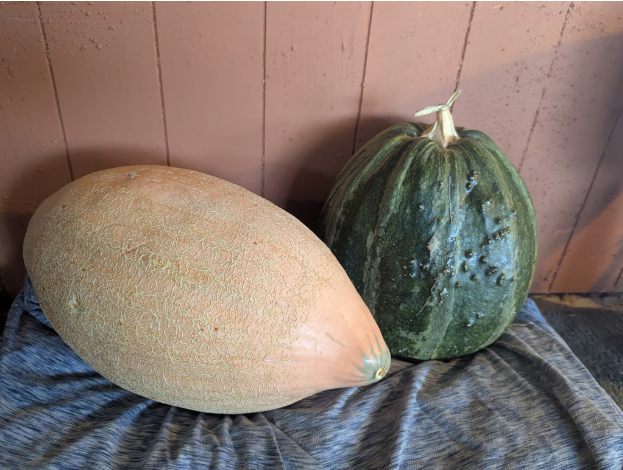
We bring our mission statement into our seed program by focusing on only the most resiliant adaptive seeds for our high desert climate. We are in NW New Mexico at 7400 feet, zone 5B, with and average of 120 day growing season. This will create a curated collection of seeds for free distribution to marginalized communities in harsh climates.
Our seeds are genetically diverse and landrace seedstock including conservation varieties bred by generations of indigenous scientists. We are then conditioning and stressing these seeds on our experimental dryland farm to produce the most, resilient, drought tolerant, short season seeds.
Our original genetics were developed by these peoples who have worked to adapt these seeds to harsh climates:
Joseph Lofthouse landrace collection from Utah high desert
Raramuri “Tarahumara” peoples of the Sierra Madres Mountains
Hopi and other peoples of the high desert south west
Hidatsa and Lakota peoples of the northern plains
Siberian/Chinese mountain developed foods
Biodiversity Conservation. Due to ongoing catastrophic drought we are losing biodiversity in our area. We have created a seed library of local wildflower species. These are important for pollinators, hummingbirds, and soil preservation. We have a wildflower seedball program using the hardiest and most common western wildflowers. We also have our Penestemon planting and seed library.
Native plant nursery coming soon.
Seed List
These are varieties that we have grown successfully, grow out trials and other varieties we have researched. We have collected information on each seed from a variety of sources trying to provide the most concise yet detailed information.
Each seed has a code above that tells you what challenges it handles best with a key for understanding. original source of the seed at bottom.
SS 60-110 days Short season
DH Drought/ heat tolerant
CS Cold/ cold soil tolerant
LR/JL Land race / Joseph loft house
CR Conservation/rematriation (rare)
GO grow outs first year trial
SV successful variety at 7400ft
Culturally significant information is included for a deeper understanding. Thousands of years of generational indigenous scientists have worked to develop these crops that feed the world. A key to success was that original crops were land races which are a genetically diverse population that can tolerate extreme conditions.
We are growing and rematriating corn and other crops on the Eastern side of the Dine’ or Navajo Nation. We are in an extremely harsh high elevation area that would not normally be used for farming.
The US gov perpetrated a long walk of the Navajo that pushed the people here and created a reservation. Changing climate, lack of water security and income makes growing food here inaccessible. The seeds grown here are being provided for free to assist with food security within the nation and for other marginalized peoples. Any future seed sales will go back to benefit the program.
Corn (zea mays)
Corn was domesticated in Mesoamerica beginning about 9,000 years ago. It spread throughout the Americas, arriving in the Southwest by 2100 BC.
The story of corn and people is a beautiful one of co-creation. Thousands of years ago, Indigenous people in modern day Central America worked side-by-side with a wild grass named Teosinte until it became what we know as maize, or corn.
From there, it traveled north and south all over the Western hemisphere along trade routes, and hundreds of different indigenous groups adapted it for their unique place on earth, where it shaped their diets and cultures.
For thousands of years, Native communities have cared for their maize despite colonizers trying to separate them from it in order to control them. Both the corn and the corn stewards have survived, and it is through the generosity of both of them that we have the gift of corn today.
Corn is a very sacred plant to the Dine’ along with beans, squash, and tobacco. The Navajo creation story says they were created from an ear of corn and the skin of Changing Woman, their most important deity. We were recently gifted and are rematriating the sacred Dine’ corn Naadaa’ it’s pollen is used for blessing and carried in a medicine pouch.
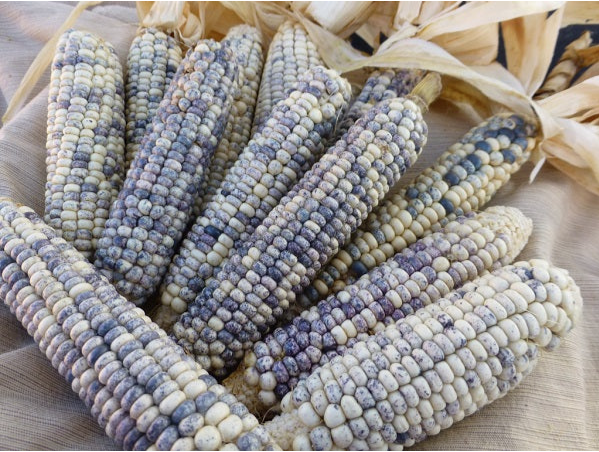
Navajo Robin’s Egg is a soft grinding flour corn, so it is dried, roasted and ground into meal for tamales and cornmeal soup. It responds better to dryer soils, so it would do well with monsoon-dry farming techniques. Traditionally, corn seeds were planted deep in the ground, around 6-7 inches deep, where soil moisture is retained. These seeds were gifted by New Mexico Spirit Farm.
SS/DH/CS/LR/CR/SV
Rarámuri Yellow Apachito (flour/flint)
(Zea mays) 100 days, day neutral
A favorite of the Raramuri, these kernels are predominantly yellow, with occasional pink or apricot. Cobs average 5-8″ in length on 4-5 ft stalks with multiple ears.
Apachitos are the fastest maturing Rarámuri corn. Used for cornmeal, tortillas, atole (a corn based drink)
https://www.nativeseeds.org/collections/southwest-traditional/products/zt036
SS/DH/CS/LR/SV
Painted mountain corn (flour/sweet)
(Zea mays) 85 days
Short efficient 3-5′ plants, long thin 6–7″ cobs. Painted Mountain is the hardiest, fastest-maturing grain corn in the world. Eaten young as sweet corn. Dave Christensen has developed it in the mountains of Montana from a diverse gene pool of about 80 strains of native corns. Contains vivid golds, oranges, reds and purples, about every shade of color known to corn. High in anthocyanins and has amazing 13% protein levels. Bred to withstand high winds, cold temperatures, intense heat and drought, and to survive global warming. Painted Mountain grows where no other corn can.
Locally sourced
SS/DH/CS/GO
Advent gulch blue corn
(Zea mays) 100 days
High-altitude adapted landrace blue corn bred in Advent Gulch, in Western Idaho near Hell’s Canyon. Extremely vigorous in cold soil.
Mike O’Brien has bred this corn at 3,500′ elevation for over 30 years. He started with a Black Aztec corn, crossed in a multi-color Indian corn and then spent several years picking out everything that wasn’t blue then crossed in a Hopi and Cherokee Blue corn. It is a mix of flour, flint, and dent corns and is wonderful for polenta as well as “corn nuts” (parched corn) pull back the husks while the cobs dry down or they will mold. Sourced from
https://snakeriverseeds.com/products/corn-advent-gulch-blue-1
SS/DH/CS/LR/JL/GO
Astronomy Domine corn (sweet)
(Zea mays) 65-75 days
A genetically diverse sweet corn landrace developed by Alan Bishop it produces multi-colored ears—often a galaxy-like mix of purple, red, yellow, white, and dark kernels that can show color even at the fresh “milk” stage (not just at full dry maturity). It has become a collaborative effort involving many breeders and growers with intent to develop the most nutritious and diverse open pollinated sweet corn ever.
Sourced from https://store.experimentalfarmnetwork.org/products/lofthouse-astronomy-sweet-corn
Hopi Wikti corn (flour)
(Zea mays) 100 days
SS/DH/CS/LR/CR
Also called Hopi Greasy Head or Hopi Purple. Beautiful, unique plum-colored kernels on 10-12″ ears, tillers well. Often planted early by Hopi farmers so the harvest can be used for the Home Dance ceremony in July. Plants are short (3′). 56 days to pollination, 103 days to dried ears. Kernels have an oily, or greasy, appearance.
https://www.nativeseeds.org/products/zf051
https://drylandcorn.com/how-to-grow-dryland-hopi-corn.php
Squash (curcurbita)
One cannot overstate the importance of squash as a source of food for the indigenous peoples of the western hemisphere. Squash is believed to be the oldest cultivated food in North America, planted long before the other “three sisters” plants (corn and beans) were cultivated.
Central American farmers first cultivated North American squash over 8,000 years ago. As time progressed, these hearty vegetables made their way across thousands of miles, settling into the gardens of tribes from New Mexico to Massachusetts.
They grow with little input and the sprawling Vines protect the soil. Delicious and nutrient dense they were easy to store providing food year-round.
Beyond food, squash served critical cultural and practical roles. Hard-shelled gourds were dried to create containers, utensils, and musical instruments, while soft squashes were consumed fresh or dried for long-term winter storage. The word “squash” itself derives from the Narragansett word askutasquash, meaning “eaten raw,”.
There are four families of Cucurbita,
C. pepo – acorn, spaghetti, delicata and summer squash (including zucchini and yellow crook neck). ornamental/ Jack-O’-Lantern (true)pumpkins.
C. moschata – butternut, tromboncino, Honey nut, cheese, seminole, calabaza. canning, french and cinderella pumpkins
C. maxima. Buttercup, kubocha, turban, Hubbard , banana type
C. argyrosperma (originally mixta) cushaw, silver seed, pepitas
SS 60-110 days Short season
DH Drought/ heat tolerant
CS Cold/ cold soil tolerant
LR/JL Land race / Joseph loft house
CR Conservation/rematriation (rare)
GO grow outs first year trial
SV successful variety at 7400ft
SS/DH/CS/LR/CR/SV
Acoma pumpkin (winter)
(C.pepo.) 90- 100 days
A productive extremely drought tolerant pumpkin from Acoma Pueblo. Round, thick-fleshed fruits are varied in color; some orange or buff, some with dark and light green stripes. Used as winter squash with thick, dense, and sweet flesh. Indigenous recipes include soups, stews, and roasted.
SS/DH/CS/LR/CR/SV
Hidatsa Squash (winter)
(C. maxima) 90 -100 days
Cultivated by the Hidatsa people of the Northern Plains along the Missouri River in present-day North Dakota and Fort Berthold Reservation in North Dakota.
Hubbard-type fruit with apricot pink skin. Fragrant, Sweet orange flesh. produces medium to large fruits, typically 10–20 inches long, with a teardrop or slightly oblong shape.Produces well under stress and drought. Excellent keeper.
Locally sourced
SS/DH/CS/CR/GO
Hopi Pale Gray (winter)
(c.maxima) 100-110 days
A rare, Southwestern heirloom winter squash originally cultivated by the Hopi people and being brought back from near extinction. Typically 2 to 5 medium-to-large squash per vine, averaging 10 lbs each. Extremely drought tolerant it is prized for its thick, hard, pale blue-gray rind and dry, deep-orange flesh. It can store for up to 2yrs! Features a mild honey-like sweetness and fruity overtones, making it an excellent base for baking, soups, and pies.
https://www.liferootfarm.com/products/hopi-pale-grey-squash
SS/CS/LR/GO
‘Lakota’ squash
(C. Maxima) 85-100 days
A smooth- and thinskinned, small-fruited, early maturing, ovoidshaped winter squash exhibiting various degrees of green and orange variegated patterns, along with some solid green and orange fruit. The original landrace was described as being elongated and cylindrical, with dark green and orange variegated skin patterns.
It has a nutty flavor and very long vigorous Vines.
Seeds of the winter squash population from which ‘Lakota’ was selected were donated to the Univ. of Nebraska, Lincoln, by A.G., who originally received the seed from the late Martha Newman, Alliance, Neb. the original squash landrace was grown by Native Americans living along the Missouri Valley.
https://www.liferootfarm.com/products/lakota-squash?_pos=1&_psq=Lako&_psid=98eaddf84&_ss=e&_v=1.0
SS/DH/LR/JL/GO
butternut squash
(C. moschata)
100 Days
butternut type landrace with some diversity in fruit shape and size, with bright orange nutrient-dense flesh, and that thrived in organic gardens with low fertility.
very early vigorous landrace. Huge vines. Very productive. Matures even in cold summers in the maritime Northwest. Keeps well. Cure one month before eating. (Note: With butternut shaped squash, you can cut off what you need of the neck, let the neck veins bleed for a few minutes, then spread the sap around the cut surface with your clean finger, which seals it so that the cut squash will keep weeks at room temperature. You don’t need to use the whole squash at once.
https://givinggroundseeds.com/products/lofthouse-landrace-moschata-squash-butternut-type-organic?_pos=2&_sid=1cd204a73&_ss=r
SS/DH/GO
Jarrahdale blue pumpkins
(c.maxima)
100 days
highly productive, with each vine producing at least half a dozen fruits. They are known for their rich, sweet flavor and blue gray waxy skin
These pumpkins can be stored for over 12 months, making them a year-round supply of squash.
Beans (Phaseolus)
Dry beans, including varieties like pinto, black, kidney, and navy beans, are native to the Americas. Archaeological evidence shows that beans were domesticated over 7,000 years ago in Mesoamerica, alongside staples like corn and squash. These three crops, often referred to as the “Three Sisters,” formed the foundation of Indigenous agricultural systems.
For Native American tribes, beans were more than a source of nutrition; they were a key element of sustainable farming. Planted together, beans fixed nitrogen in the soil, which benefited the corn, while the squash provided ground cover to reduce weeds and retain moisture. This intercropping method demonstrated an advanced understanding of ecological balance.
Four major species of beans were domesticated by Native Americans in ancient times, with common beans (Phaseolus vulgaris) being the most widespread, cultivated as early as 5000 B.C.E. in Mexico. This bean variety encompasses numerous types, such as pinto, kidney, and navy beans, and was a staple in many regions, especially North America. Other notable species include tepary beans (Phaseolus acutifolius) from the American Southwest and lima beans (Phaseolus lunatus), which were domesticated in both Peru and Central America. The cultivation of runner beans (Phaseolus coccineus) also began in Mexico around 200 B.C.E.
SS 60-110 days Short season
DH Drought/ heat tolerant
CS Cold/ cold soil tolerant
LR/JL Land race / Joseph loft house
CR Conservation/rematriation (rare)
GO grow outs first year trial
SV successful variety at 7400ft
SS/DH/CS/CR/SV
Blue Speckled Tepary
(Phaseolus acutifolius)
80 days.
Tan and blue-grey spotted beans that were historically an important food in Mexico and the Southwest. They are drought and heat-tolerant and it is important not to over-irrigate them. They have evolved to mature quickly following monsoonal summer rains in the Southwest. Seeds and pods are smaller than common beans and they have nutritional value.
SS/DH/CS/CR/GO
Rarámuri Tekomari
(Phaseolus coccineus)
Large, incredibly beautiful runner beans from high elevation lands of the Rarámuri in the Sierra Madre in Chihuahua, Mexico. The red flowers attract and feed hummingbirds. The dry beans are large and creamy in texture … wonderful for soups and stews. The bean is named after a stream in the Rarámuri territory.
These beans will not produce in the low desert … runner beans drops their blossoms when temperatures get above 85 to 90 degrees F, especially in our dry heat, and cannot produce fruit.
SS/DH/CR/GO
Rarámuri Mix
(P. vulgaris)
A farmers variety that includes several different colors and shapes: a little of everything from yellow, purple and black to pinto, ojo de cabra and speckled. This high desert bean originally came to us in 1985 from a Rarámuri farmer in Nabachique, Chihuahua, Mexico. Said to produce good green beans, though moderately stringy. The farmer grew this as a sprawling bush variety, but some of the plants will climb if given support.
Other varieties.
SS 60-110 days Short season
DH Drought/ heat tolerant
CS Cold/ cold soil tolerant
LR/JL Land race / Joseph loft house
CR Conservation/rematriation (rare)
GO grow outs first year trial
SV successful variety at 7400ft
SS/DH/CS/LR/JL/GO
watermelon
(C.lanatus)
60-85 days.
With lots of genetic diversity, not every watermelon is going to be ripe at once, so you can pick and eat them progressively. Plus, the diversity of colors and flavors of this landrace are amazing, from yellow flesh, to orange and deep red, range of sizes, from 2-8 lbs.
Cool nights don’t bother it, and these watermelons also thrive in low-input, low-fertility, and organic conditions.
cross-pollination: Blacktail Mountain and Chin Sun.
2026 crossing with Mayo Sandia
https://givinggroundseeds.com/products/watermelon-lofthouse-landrace
SS/DH/CS/LR/CR/SV
Mayo sandia watermelon
(C.lanatus.)
100 days
Small, sweet, red-fleshed melons from a Mayo farmer in Piedras Verdes, Sonora, Mexico. Traditionally dry farmed and planted with the rains in June/July.
SS/DH/SV
Prescott Fond Blanc Cantaloupe
(C. melo)
80 Days
This variety is drought-tolerant and does well in our short season. They enjoy some drought stress to ripen and take on an intoxicating sweetness and aroma. A prized French melon, these have a squat and ribbed shape with bumpy skin. Their grey/green skin turns straw color when ripe with salmon-orange flesh. Prescott will not slip and is best picked slightly immaturely and left to ripen on the counter.
Rarámuri “Chicharos”
(Pisum sativum)
A soup pea from the Sierra Madre in northern Mexico. Grown along the edges of Rarámuri bean and corn fields. Plant in late fall or early spring in warmer climates.
Thelma Sanders Squash
(C.pepo)
85-90 Days
Super productive winter squash producing acorn shaped fruits with a cream colored skin. Its rich sweet flavor and texture gives it the nickname the “sweet potato squash.”
Silver edge squash (Cucurbita argyosperma)
Joseph loft house land race cushaw squash
For more information https://aihd.ku.edu/index.html